
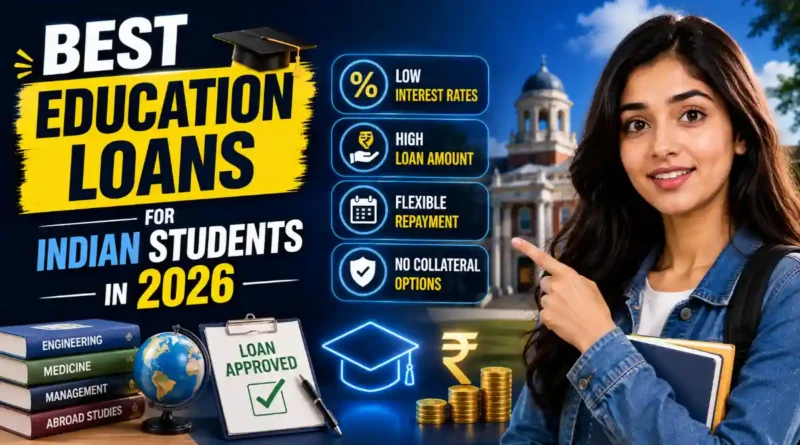
Best Education Loans for Indian Students in 2026
Higher education in India isn’t cheap anymore. An engineering seat at a top private college can cost anywhere from ₹15 lakh to ₹40 lakh for the full course, medical degrees often cross ₹50 lakh, and an MBA abroad can run past ₹1 crore once you add living expenses. For most middle-class families, saving up that kind of money isn’t realistic — which is exactly why education loans have become the default way Indian students fund their degrees.
The good news is that 2026 offers more choice than ever before. Public sector banks, private banks, NBFCs, and a new government-backed scheme are all competing for student borrowers, which means better rates and faster approvals if you know where to look. This guide walks you through the best education loan options available right now, how interest rates compare, and how to pick the right one for your situation.
Why Education Loans Matter More in 2026
Tuition costs have kept climbing faster than family incomes, and that gap is now the norm rather than the exception. On top of that, more students are applying to premier institutes and international universities, both of which come with steeper price tags. An education loan doesn’t just cover the funding gap — it also lets you build a repayment record early, which helps with future credit needs like a home loan.
The lending landscape has also matured. Public banks have digitized much of their process through the Vidya Lakshmi Portal, private lenders now offer near-instant in-principle approvals, and a new central scheme is making collateral-free loans available at select institutes. That said, rates and terms still vary widely, so comparing lenders before signing is non-negotiable.
Top Education Loan Options in India for 2026
1. SBI Education Loans (Scholar Loan & Global Ed-Vantage)
State Bank of India remains the benchmark for affordability. Its Scholar Loan, meant for students admitted to IITs, IIMs, NITs, and other listed premier institutes, carries some of the lowest rates in the country. Its Global Ed-Vantage product is built for students heading abroad and covers loan amounts that can run into crores for tuition, travel, and living costs. SBI’s biggest strength is pricing; its main drawback is processing time, which can stretch to two or three weeks, and it tends to insist on collateral once the loan crosses ₹7.5 lakh.
2. Bank of Baroda Scholar Loan
Bank of Baroda is SBI’s closest rival on price and is often the second call for students who don’t get through SBI’s eligibility filters. It offers both domestic and international study loans, with reasonably quick disbursal once documentation is in order. Like SBI, it leans on collateral for larger loan amounts.
3. Union Bank, PNB, and Central Bank of India
These public sector banks round out the low-cost tier. Union Bank and Central Bank in particular have been aggressive on starting rates this year, making them worth a look if SBI or Bank of Baroda isn’t a fit — whether due to branch access, documentation gaps, or a course that doesn’t qualify for their flagship schemes.
4. Axis Bank and ICICI Bank
Among private banks, Axis and ICICI are the most active in the education loan space. Their rates sit a notch above public banks, but they make up for it with faster processing, more digital-first applications, and often more flexibility on which courses and colleges qualify. If speed matters more than shaving off the last percentage point of interest, these are solid choices.
5. HDFC Credila and Avanse
These are India’s largest dedicated education loan NBFCs, and they specialize in funding students heading abroad, including for courses that traditional banks are cautious about. Both are known for high approval rates and loans that don’t always require collateral, though this convenience comes at a higher interest cost. They’re particularly useful for students who don’t have property to pledge or who need a loan sanctioned quickly to meet an admission deadline.
6. Propelld and Other New-Age NBFCs
A newer set of NBFCs has entered the market focused on collateral-free, merit-based lending, often with quicker digital approvals aimed at students in medical, engineering, and vocational courses. These lenders sit at the higher end of the rate spectrum but can be a lifeline when banks turn a student down.
Government Schemes Worth Knowing About
The PM Vidyalaxmi Scheme is the standout government initiative this year. It offers collateral-free, guarantor-free education loans to students admitted into roughly 860 top-ranked institutions across India. It comes with a credit guarantee covering a large share of the loan and an interest subvention of about 3% for families earning up to ₹8 lakh a year — a meaningful saving if your household qualifies.
State-level programs are also worth checking. Schemes like the Bihar Student Credit Card Yojana provide subsidized, low-collateral loans to residents of that state, and several other states run similar initiatives. If you’re eligible for one, it’s usually cheaper than a standard bank loan.
How Interest Rates Compare in 2026
Rates this year broadly fall into three tiers:
- Public sector banks: roughly 6.9% to 10.75%, with the lowest rates reserved for premier-institute schemes like SBI’s Scholar Loan.
- Private banks: roughly 9% to 13.5%, trading a slightly higher rate for faster turnaround and more flexible eligibility.
- NBFCs: roughly 11% to 16%, mostly for unsecured loans or students who don’t fit neatly into bank criteria.
Most lenders also offer a 0.5% interest concession for female students, so it’s worth asking about explicitly if it applies to you.
Factors to Consider Before Choosing a Lender
Collateral requirements. Loans above ₹7.5 lakh from public banks typically need collateral, usually property or fixed deposits. NBFCs and some private banks offer collateral-free options but charge more for the risk.
Moratorium period. Nearly all education loans let you skip EMIs during your course plus a grace period afterward, usually up to a year. Interest still accrues during this time, so the amount you eventually repay is higher than what you borrowed — factor this into your planning rather than treating the moratorium as free money.
Processing time. Public banks are cheaper but slower, often taking two to three weeks. If you’re racing an admission deadline, a private bank or NBFC might be the more practical choice even at a higher rate.
Course and college eligibility. Not every lender covers every institution or course. Always confirm eligibility before you count on a particular bank.
Tax benefits. Interest paid on an education loan is deductible under Section 80E of the Income Tax Act, with no upper limit on the amount, for up to eight years from when repayment starts. This applies regardless of which lender you choose, so it’s a benefit worth factoring into your overall cost comparison.
Final Thoughts
There’s no single “best” education loan in 2026 — the right choice depends on your course, your college, whether you have collateral, and how quickly you need the funds. If you qualify for a premier institute and can wait out the processing time, SBI or Bank of Baroda will usually save you the most money. If speed or a collateral-free option matters more, Axis, ICICI, HDFC Credila, or Avanse are worth exploring. And before signing anything, check whether PM Vidyalaxmi or a state-level scheme applies to you — the interest subvention alone can be worth lakhs over the life of the loan.
Whichever route you take, run the numbers through an EMI calculator with the moratorium period included, and compare at least three offers before committing. A one or two percent difference in interest rate sounds small on paper but adds up to a significant amount over a loan tenure of eight to ten years.